Friendship with Moscow, Fear of the West, and an Attack on Legitimacy: How Russia Sought to Influence the Vote in Armenia


Lose the election, then demand that its results be annulled. That is exactly what the pro-Russian opposition did in Armenia, where pro-Western Prime Minister Nikol Pashinyan won convincingly on 7 June 2026. A separate but no less fierce battle was fought not at the polling stations but on Telegram.
Armenia was the target of one of Russia’s most intensive attempts at election interference. Initially, the strategy involved criticizing the government, promoting close ties with Moscow, and rejecting the country’s pro-Western course. When that did not work, pro-Russian forces chose a different tactic: undermining trust in the elections themselves.
As early as election day, a coordinated campaign unfolded on Telegram that sought to create the impression that the opposition was winning. And within a few days, the pro-Russian political force began demanding that the results be declared invalid.
The CHESNO Movement, together with the analytics company Spectra Data, analyzed 425,000 messages from nearly 200 Armenian Telegram channels over the period from 1 January to 8 June, and established how pro-Russian forces tried to change the course and the results of the elections.
The legitimacy of the elections
On 7 June 2026, Armenia elected a new parliament, and the vote became a choice about the country's geopolitical course: pro-Western Prime Minister Nikol Pashinyan versus the pro-Russian opposition, which promised to restore warm relations with Moscow. Pashinyan's Civil Contract party won, taking almost 50% of the vote; the Strong Armenia bloc, led by billionaire Samvel Karapetyan, came second with about 23%, while former president Robert Kocharyan’s Hayastan bloc failed to reach even 10%.

The opposition did not recognize the results. Already on 12 June, despite the huge margin, Strong Armenia filed a complaint with the Central Election Commission demanding that the vote be annulled, citing "violations during the voting." International observers, meanwhile, assessed the electoral process as generally calm, free, and well organized. Yet the party that lost by a margin of more than two to one is demanding that the elections be annulled entirely.

The demand to declare the election illegitimate did not arise out of nowhere, as the most interesting events took place not at the polling stations but on social networks. As early as election day, 7 June, a coordinated attack unfolded on Telegram aimed precisely at undermining the legitimacy of the vote: dozens of channels synchronously published their own parallel vote counts, which purported to show an opposition victory. Although the official result turned out to be the opposite, the groundwork had already been laid for a legal challenge.
It is worth noting that social media long ago overtook television as the main source of political information in Armenia, and it was into this space that Russian influence shifted. Telegram became the key platform – specifically, pro-Russian channels with hundreds of thousands or even millions of subscribers.
The campaign against the results
To understand the scale of the information campaigns in Armenia's elections, we collected and analyzed 425,000 messages from nearly 200 Armenian Telegram channels – both Armenian-language and Russian-language (roughly 58% of messages were in Armenian and 42% in Russian).
The first thing that stands out is that a significant part of the "public opinion" expressed here did not appear organic. Every seventh message (about 15%) turned out to be a verbatim copy published simultaneously on two or more channels. Most duplicates appeared synchronously, within a few hours, and often within minutes.
Throughout the entire pre-election period, an active campaign against the incumbent Prime Minister Nikol Pashinyan continued on Telegram. The thematic cluster of grievances directed at him numbered more than 13,000 messages, and this was not a one-off wave but a constant backdrop throughout the campaign, averaging roughly 500 messages a week and peaking in mid-May.
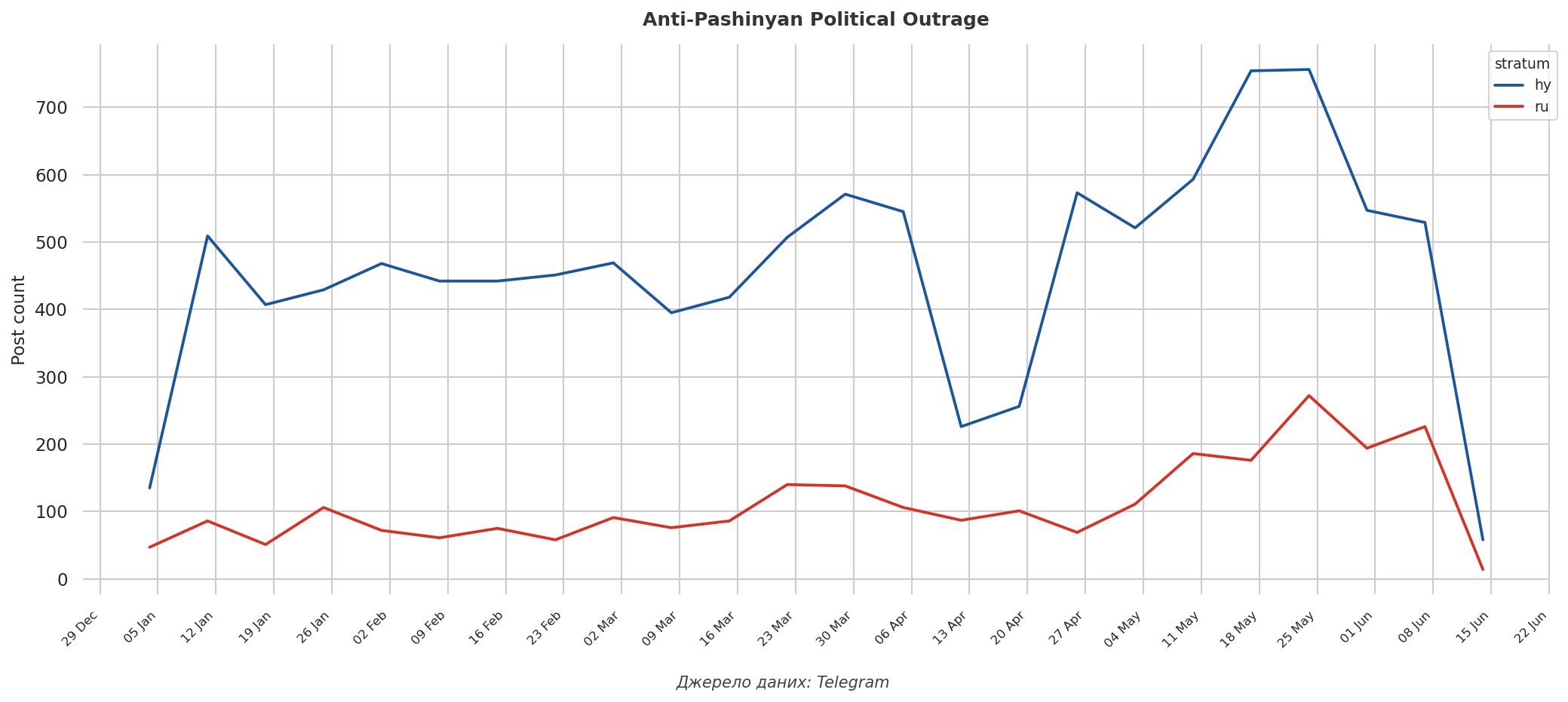
The content boiled down to a few persistent emotional frames built around accusations. Pashinyan was portrayed as a "capitulator," a "dictator whose regime is coming to an end," and "a man who brings war."
When it became clear that efforts to damage the prime minister's approval rating were not working, the focus shifted from Pashinyan himself to the election. On election day, the number of coordinated messages quadrupled to a peak of about 3,500 identical messages across more than a hundred channels within a day. This surge mainly focused on two topics: the election results and alleged violations on voting day.
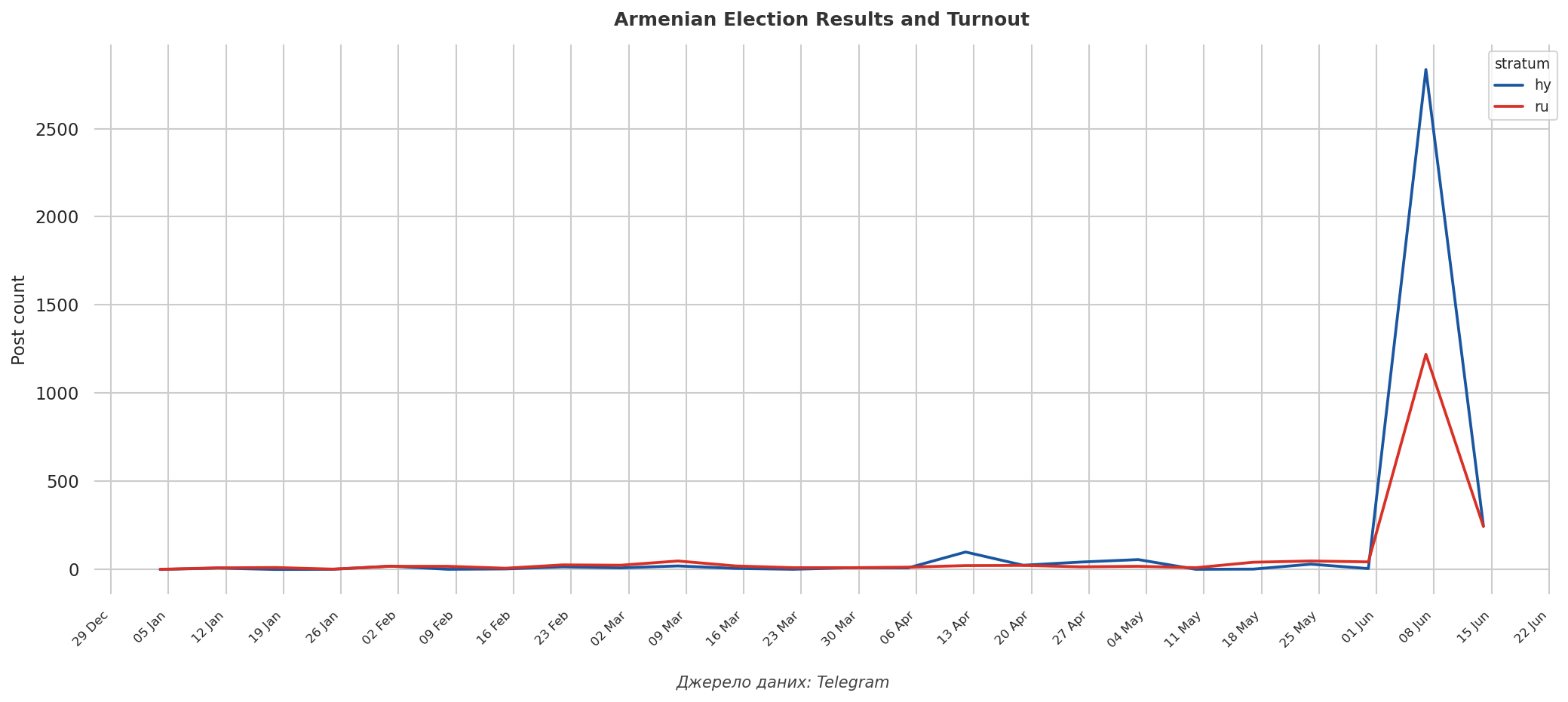
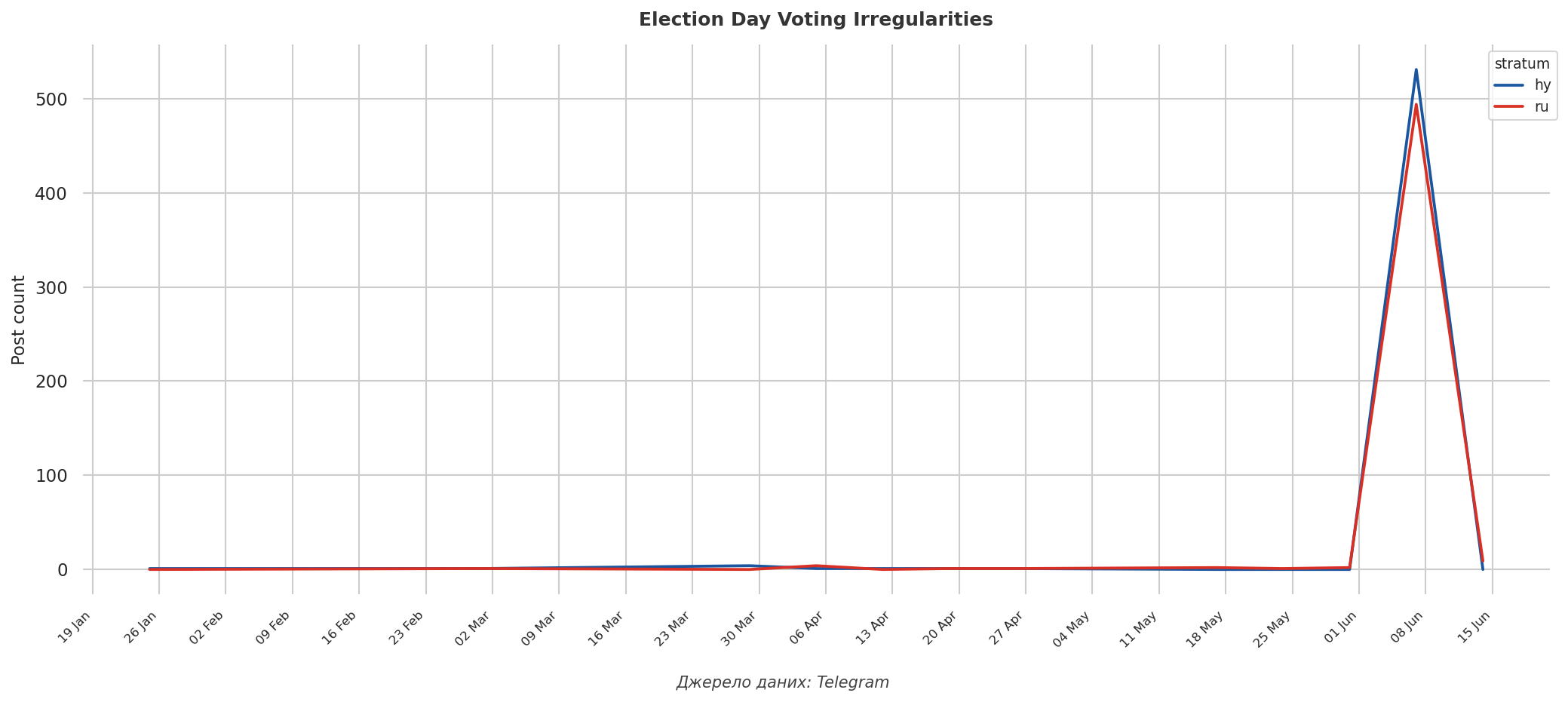
Several indicators point to the coordinated nature of the campaign. First, more than 40% of posts concerning the results and alleged violations during the elections were "copy-pasted" – that is, identical texts were published on several channels at once. By comparison, copied messages accounted for only 15% of all posts analyzed.
Second, identical texts spread across dozens of channels within minutes. Reposts appeared after the original post with a median delay of less than two minutes, and 98% within an hour.
A significant portion of these posts effectively concerned a "parallel count." Notably, according to the Telegram channels publishing these figures, the united opposition was supposed to win. Moreover, this "parallel count" was carried out almost exclusively by opposition channels.

At the same time, a stream of messages flowed about violations during the elections, ranging from alleged ballot stuffing to accusations that pro-government candidates were pressuring voters. The groundwork had been laid in advance: while the campaign was still underway, nearly identical reports of abuses of power appeared on various channels.

Most tellingly, the official result turned out to be the opposite of what these Telegram channels had claimed, yet discussion of the election’s legitimacy intensified rather than dying down after the vote. By the next day, the share of posts about falsification, appeals, and non-recognition of the result had increased. A few days later, an official complaint demanding that the election be annulled was filed against the backdrop of this narrative, which had been prepared in advance on social media.
Not by legitimacy alone
The attack on the course and results of the election was only the tip of the iceberg. In fact, the campaign consisted of several broad themes and a long list of narrower narratives. It should be noted that in the months preceding the election, the flow of information on Armenian Telegram channels was extraordinarily politicized.
The most popular topics by number of posts were the security of Armenia and the Middle East (more than 61,000 publications), clashes during the pre-election campaign (more than 20,000), grievances directed at Nikol Pashinyan (13,600), and discussion of the Russo-Ukrainian war and the nuclear threat (13,000).
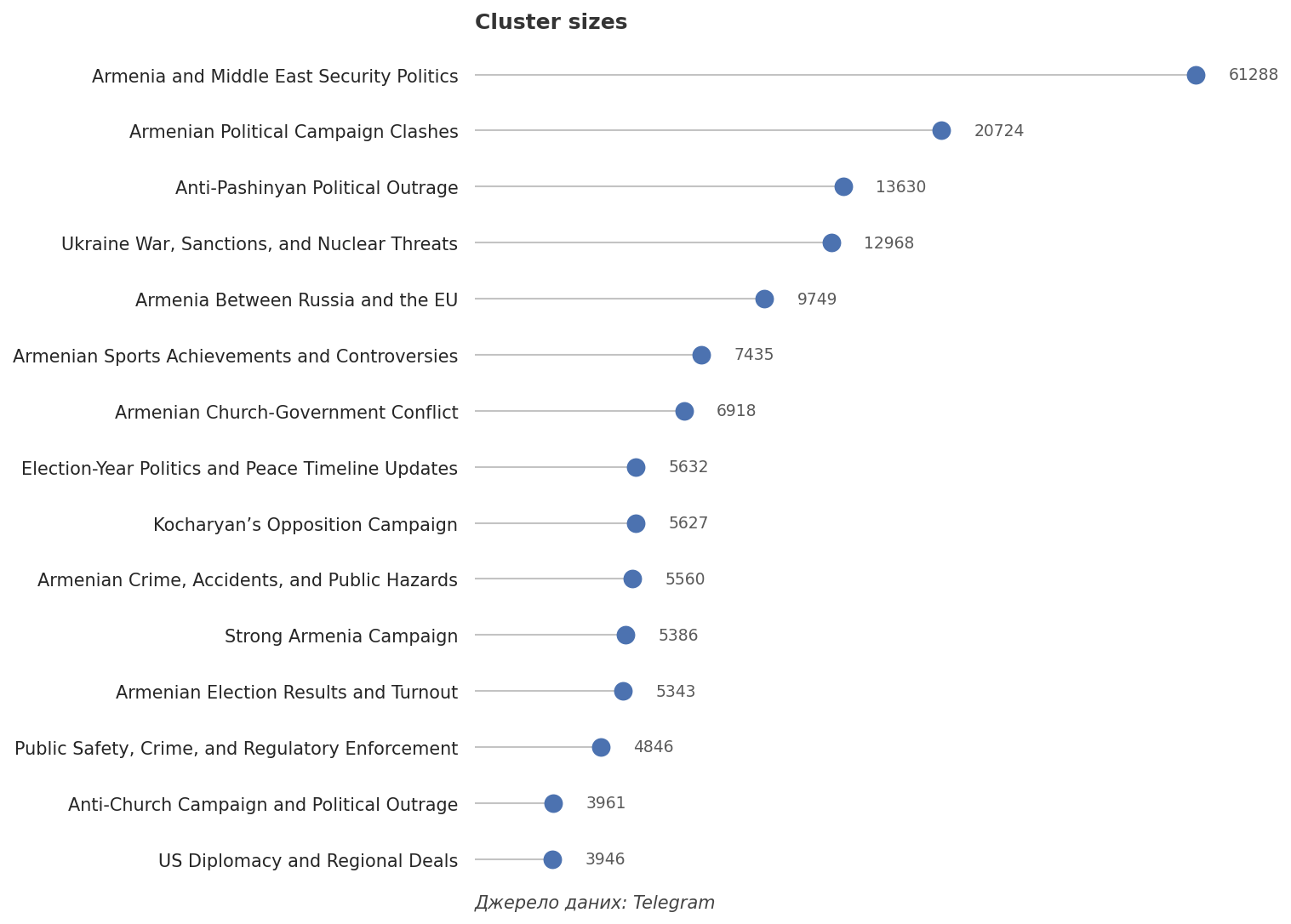
The subject matter of discussions and posts was also closely tied to the language of the publications. International politics was discussed almost entirely in Russian, effectively imposing the Kremlin's agenda. Thus, the vast majority of posts about the war in Ukraine were published in Russian.
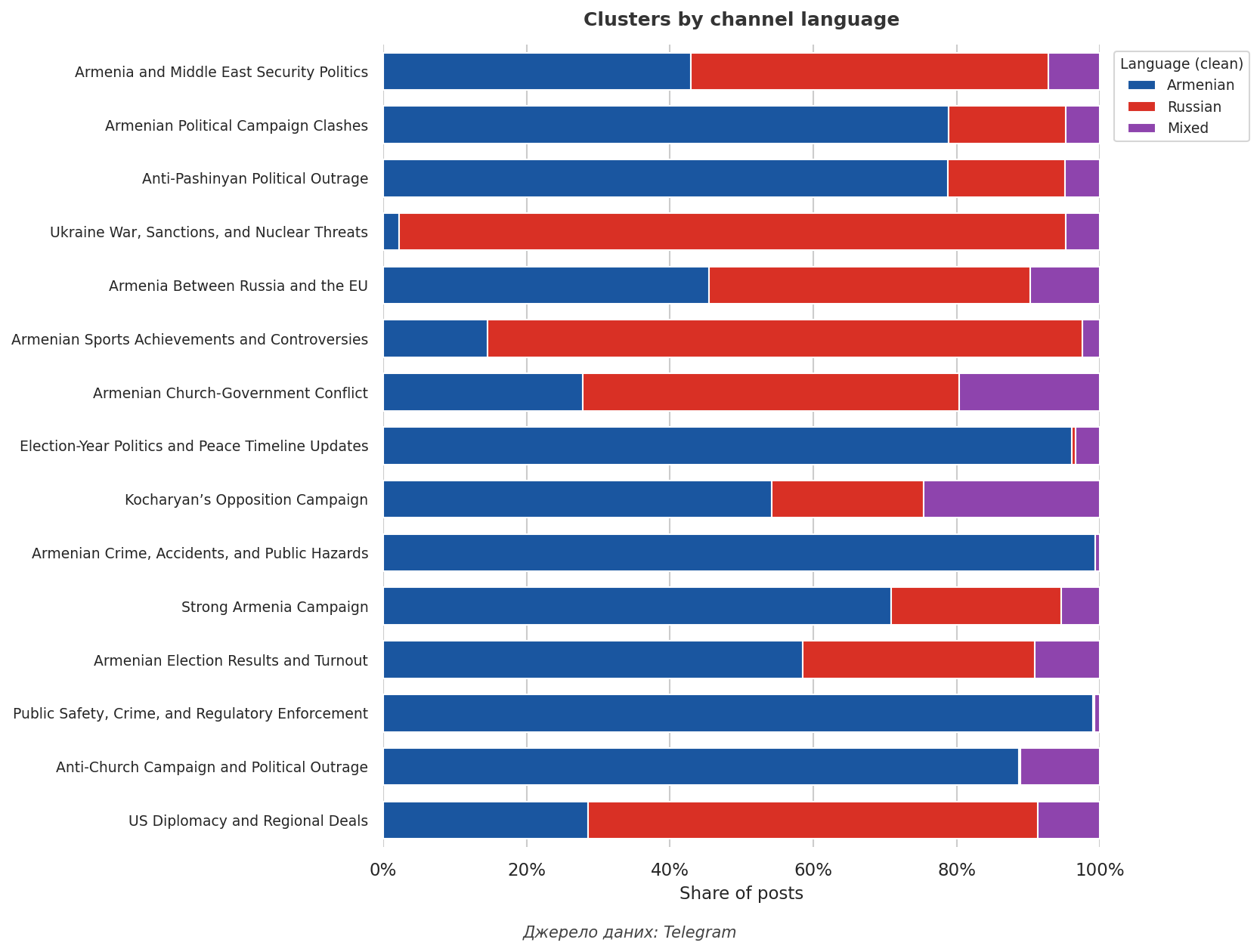
By contrast, posts about domestic politics were in Armenian. For example, direct attacks on Pashinyan were published mostly in Armenian, while explanations of why he is "bad," with references to geopolitics, the "threat of the West," and praise of Russia, were mostly in Russian.
It is worth singling out the attempts by pro-Russian forces to influence Armenia’s information space. Initially, these efforts focused not on the legitimacy of the election but on cultural and economic topics. Thus, Russian-language channels actively circulated posts about "Armenian-Russian cultural heritage," including the shared Soviet past, the preservation of the legacy of the Second World War, and the need for unity with Moscow.
Some Armenian channels even actively circulated an interview with Alexander Dugin, one of the chief ideologues of the "Russian world" and a self-styled "philosopher," in which he argued that "granting access to the internet" should be used as a form of reward.
The information pressure was quite blunt in the economic dimension. For example, Telegram channels actively disseminated posts claiming that American modular reactors would not be able to replace Armenia's nuclear power plant. At the same time, these publications contrasted this with an "advantageous" Russian offer of cooperation.

It was not only the topic of energy security that was politicized. They also wrote about the success of the "Georgian model" – claiming that Georgia, by rejecting "Brussels' advice," had saved its economy.
Another important theme of the campaign was religion. The government's conflict with the Armenian Apostolic Church had been ongoing since 2025: Pashinyan publicly demanded the resignation of Catholicos Garegin II, proceedings were opened against a third of the archbishops, and Archbishop Bagrat Galstanyan was arrested on charges of plotting a coup.
On Telegram this topic was promoted precisely by pro-Russian channels: the "Church-versus-government conflict" cluster comprised almost 7,000 posts, 71% of them in Russian, and generated significant reach (about 15 million views) as well as a high share of identical posts and reposts.

The logic of these posts was as follows: the government's actions amounted not to justice but to persecution and a war against its own people. This gave rise to the thesis that “the Catholicos’s decisions are not subject to judicial review” and to outrage over the suspension from ministry of priests who had refused to support Pashinyan.

In parallel, there was outright mobilization – "Armenians, it's time to fall into line!" And priests who sided with the government were branded traitors who had "violated the vow of the Holy See."
The 2026 elections. Between Moscow and the West
To understand the 2026 campaign, one must recall the position from which Armenia entered it. Back in September 2023, Azerbaijan established control over Nagorno-Karabakh in a single day, and by the end of the month, about a hundred thousand people – that is, almost the entire Armenian population – had left the region. For part of the public, this became a source of trauma and a reason to accuse Prime Minister Nikol Pashinyan of surrendering territory.
Pashinyan himself pursued a pro-Western course and sought to distance Armenia from Moscow – to the point of signing a joint declaration with Baku on the TRIPP corridor (Trump Route for International Peace and Prosperity) at a White House summit in August 2025, granting the United States exclusive rights over a transit route through Armenia's Syunik region. This enraged the Kremlin.
The pro-Russian opposition was represented by two figures. Robert Kocharyan, a representative of the "Karabakh clan," was the first president of the unrecognized Nagorno-Karabakh Republic (NKR) and the second president of Armenia, serving until 2008. His Hayastan bloc effectively insisted on closer coordination with Moscow.
The use of the topic of Karabakh in the campaign deserves separate mention. A network of Karabakh-focused Telegram channels emerged in Armenia, including My Homeland – Artsakh, Miatsum, and ArtsakhInfo. The network was almost entirely Russian-language: of the 121 channels linked by these reposts, 97 were exclusively Russian-language, while only eight published in Armenian.
Repost network surrounding the Karabakh topic. Node color indicates channel language; size indicates repost intensity
This is not surprising, since the largest sources amplified by the Karabakh network included pro-Russian channels (Armenian Vendetta, Alpha News, and the Russian-language Yerevan Today Rus) as well as, tellingly, Robert Kocharyan's personal channel.
The AnnaNews channel also deserves a separate mention. Judging by the repost network, it is connected to a network of disinformation channels in neighboring countries, including the “In Fact in…” network of city-specific channels covering the Ukrainian cities of Donetsk, Kyiv, Dnipro, Zaporizhzhia, and Kherson. Posts from AnnaNews were actively reposted by Karabakh-related channels.
A new figure also emerged in this year's Armenian elections: Samvel Karapetyan, a Russian-Armenian billionaire who had been arrested in the summer of 2025 for "public calls to seize power" after siding with the Church. He later became the face of the Strong Armenia opposition bloc. On election day, Karapetyan was escorted to the polling station from house arrest.
It should be noted that less than a day before voting began, six candidates from Strong Armenia were detained. At the same time, international OSCE/ODIHR observers assessed the election as well organized, while separately emphasizing direct external pressure aimed at swaying voters in favor of the opposition.
It is important to understand that election interference does not end on voting day. We routinely observe campaigning and violations at polling stations. The Armenian case, however, shows another, equally important stage: an attack on the legitimacy of the results.
When victory cannot be achieved, the goal shifts to sowing doubt about the fairness of the vote's outcome. The groundwork for this is laid in advance, the attack begins on election day, and activity peaks in the days following the vote.
Russian influence tactics recur from country to country. One such tactic is the use of third parties – that is, networks of "news" channels on Telegram – instead of the official pages of parties and candidates. As noted in an earlier CHESNO Movement report, similar problems also arose during elections in Hungary.
Methodology: the analysis is based on a dataset of 425,220 messages from 197 Armenian Telegram channels, collected over the period from 1 January to 8 June 2026. To identify thematic content groups, clustering based on machine-learning algorithms using large language models was applied. The data was provided by the analytics company Spectra Data.


Related articlesRead more

Peace, Zelensky, Druzhba – How Political Campaigning Unfolded on Social Media During the Hungarian Elections


Американська лотерея: як Трамп та Гарріс змагаються за тих, хто вагається

В орбіті російського впливу: що показали вибори в Молдові?
Поділитись